




At a Glance: Federal rules cap a professional truck driver’s hours each week, often called the 70-hour clock. The 34-hour restart is the fastest way to reset that clock. When you spend at least 34 hours in a row off duty, whether that’s in the sleeper berth or at home, your weekly hours reset to a full week. You can park and reset anywhere safe and legal, but the tricky part is finding a secure, quiet place to park for that day and a half.
Running low on hours is part of life for anyone driving a commercial motor vehicle. The 34-hour restart is the quickest way to get a full week of hours back, but it is also one of the most misunderstood rules in the trucking industry. A lot of the advice drivers trade at the truck stop counter is years out of date. This guide explains how the restart actually works as of June 16, 2026, when to use it, how to stay clear of an hours-of-service (HOS) violation, and where to park while the clock resets.
How the 70-Hour Clock Works
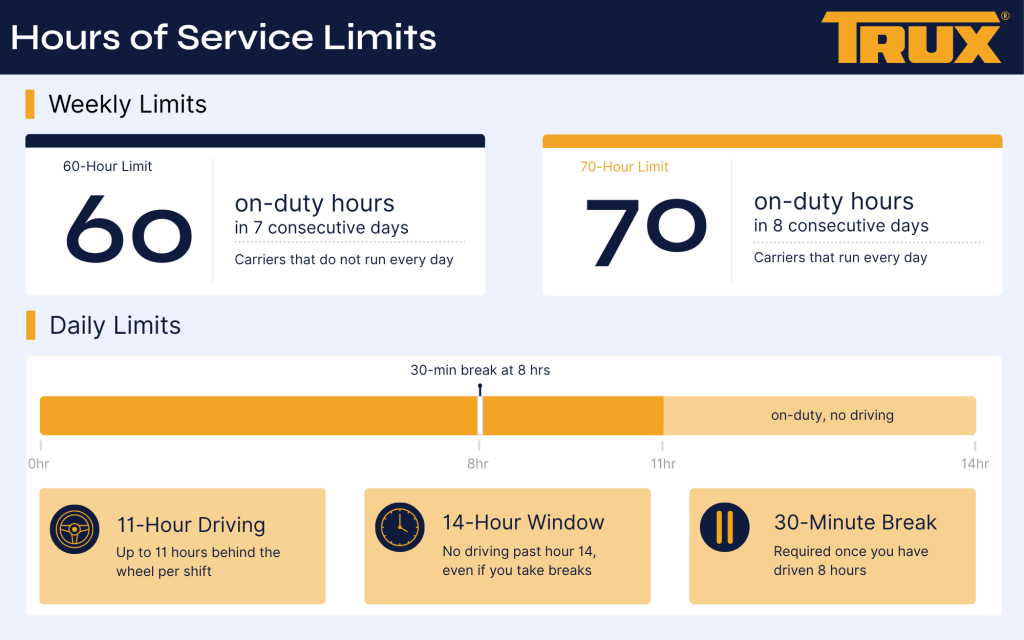
The 70-hour clock adds up your on-duty hours over a rolling stretch of days rather than resetting every calendar week. It comes in two versions, and your carrier runs on whichever fits its schedule. Carriers that operate every day use the 70-hour limit, which caps you at 70 on-duty hours over any 8 days. Carriers that take days off run on the 60-hour limit, capped at 60 hours over any 7 days. You are on one or the other, not both.
A few daily limits apply no matter which version you are on. Once you come on duty, you have a 14-hour window to drive, and you can be behind the wheel for up to 11 of those hours. After 8 hours of driving, you need a 30-minute break. When your shift ends, you take 10 hours off duty before you can drive again. These rules cover most long-haul drivers. Short-haul drivers who stay within a 150-mile radius of their home base and finish within 14 hours can skip the electronic logging device and the 30-minute break, keeping a simple timecard instead.
What counts as on-duty time
Your weekly clock is built from on-duty hours, and driving is only part of that. On-duty time also includes work like fueling, loading and unloading, inspections, and paperwork. Time logged as off duty or in the sleeper berth does not add to the clock, which is exactly why the restart works the way it does.
How to Avoid Hitting the Limit
The clock works in your favor if you plan around it. The hours you use are not gone for good. As each day ages out of the rolling window, the hours you logged that first day come back to you. Keep your daily driving hours fairly even, and the time coming back tends to keep up with the time you spend, so a well-planned week lets you run without ever hitting the limit. Drivers usually run short only when a stretch of long days piles up faster than the old hours clear. That is when a 34-hour restart comes in.
What Is the 34-Hour Restart?
The 34-hour restart rule is a provision under the federal hours-of-service (HOS) regulations set by the Federal Motor Carrier Safety Administration (FMCSA), and most long-haul operations plan around it. In plain terms, it gives you a way to wipe your weekly hours back to zero. Instead of waiting for old hours to roll off your log one day at a time, you take a single rest period of at least 34 consecutive hours off duty. When it is done, your 60 or 70-hour clock starts fresh.
Taking a restart is optional, but most drivers reach for the 34-hour break when their hours run low and they need a full week back fast. The catch is having somewhere safe to spend those 34 hours, which is why planning your stop matters.
How to Take a 34-Hour Restart
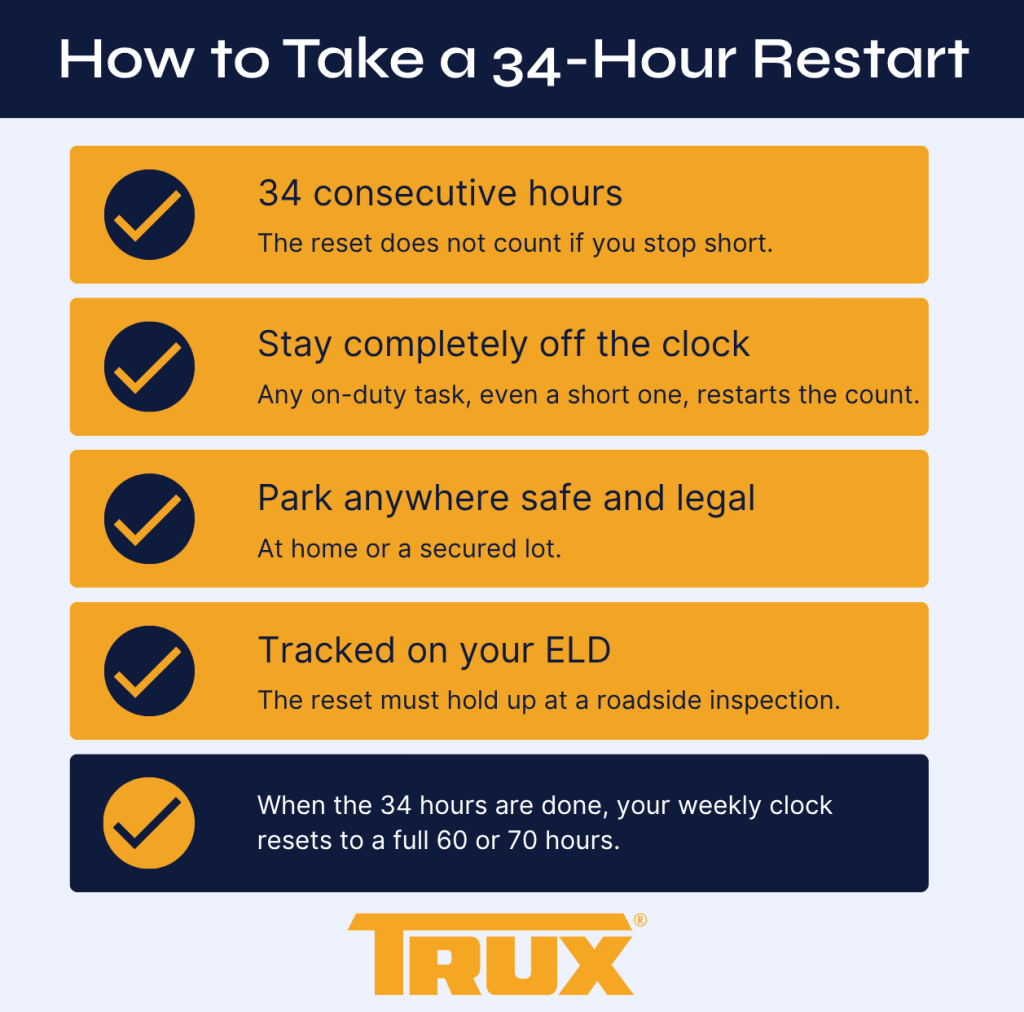
The mechanics are simple once you know them. To complete a valid 34-hour reset, follow these basics:
- Log at least 34 consecutive hours with no on-duty time
- Spend that time off duty, in the sleeper berth, or at home
- Do not perform any work-related activities during the rest period
- Let your electronic logging device track the time so your records stay clean
Once the 34 consecutive hours are complete, your 60 or 70-hour limit resets, and your available hours are full again.
What can trip drivers up is that the rule used to be stricter. A 34-hour restart used to require two nights off covering the hours between 1 a.m. and 5 a.m., so it had to span two real nights of sleep. That requirement was dropped, and today a restart is simply 34 hours in a row off duty, no matter what time of day it starts or ends.
What Can Break a Restart
The restart only counts if the full 34 hours stay clean.
What to avoid:
- Logging any on-duty work in the middle of the period, even a short task restarts the count
- Mixing up duty status on the ELD
- Cutting the rest short and assuming a partial reset still counts
You do not have to sit completely still for 34 hours. Certain off-duty driving can be done without ending the restart, but what qualifies is narrow enough that you should confirm it with your carrier and the FMCSA guidance first.
When Does a 34-Hour Restart Make Sense?
The restart is a tool, not a requirement, so the real question is when to reach for it. It tends to pay off in situations like these:
- Your weekly hours are nearly used up, and you have a full load waiting
- You are early in the week and want a clean slate before a heavy run
- Letting hours roll off one day at a time would leave you sitting too long anyway
- You need real rest after a stretch of hard miles, and driver fatigue is setting in
Here is a simple way to compare your two options when the clock gets tight:
| Option | Best when |
|---|---|
| Let hours roll off | You only need a few hours back and can wait a day or two |
| 34-hour restart | You need a full week of hours back as quickly as the rules allow |

Where to Park During Your 34-Hour Reset
34 hours of rest sounds simple until you have to find somewhere to spend it. Public truck stop spaces fill up fast in the evening, and an unsecured lot is the last place you want to leave your truck and trailer for a day and a half. TRUX Parking gives you gated access, 24/7 cameras, industrial lighting, and perimeter fencing, wide stabilized lanes sized for full rigs, and flexible daily or monthly parking with no contracts or hidden fees. Book online and get instant access instructions, and skip circling a crowded lot at midnight.
With secure lots across the United States, TRUX turns your restart into real rest instead of a stressful scramble. Select locations also offer Wi-Fi, trash service, and on-site diesel mechanics.
Visit our secure facilities in:
- Georgia
- Tennessee
- Alabama
- Texas
- Missouri
- Idaho
- Mississippi
- Arkansas
- Oklahoma
- Ohio
- California
- Iowa
- Pennsylvania
- North Carolina
- Florida
- Oregon
- Nevada
- South Carolina
- Arizona
- Washington
Reserve your spot with TRUX Parking today and make your next 34-hour restart the easiest part of the week. Your home away from home is ready when you are.