


Starting a trucking company means setting up a legal business entity, registering with federal agencies, securing the right equipment and insurance, and building a freight network. The process is the same whether you are an experienced professional driver going independent or an entrepreneur entering the industry from the outside. This guide covers each step so you know what to expect going in.
Understand What You Are Getting Into
Before anything else, be honest with yourself about what running a trucking business involves. Driving and owning are two different jobs. As a business owner, you are responsible for maintenance costs, fuel costs, insurance, compliance, payroll if you hire, and keeping cash flow positive when freight slows down.
The trucking industry offers real opportunities, but it also has thin profit margins. Fuel consumption alone can eat through your budget fast. Go in with a clear picture of the costs involved so you are not caught off guard three months down the line.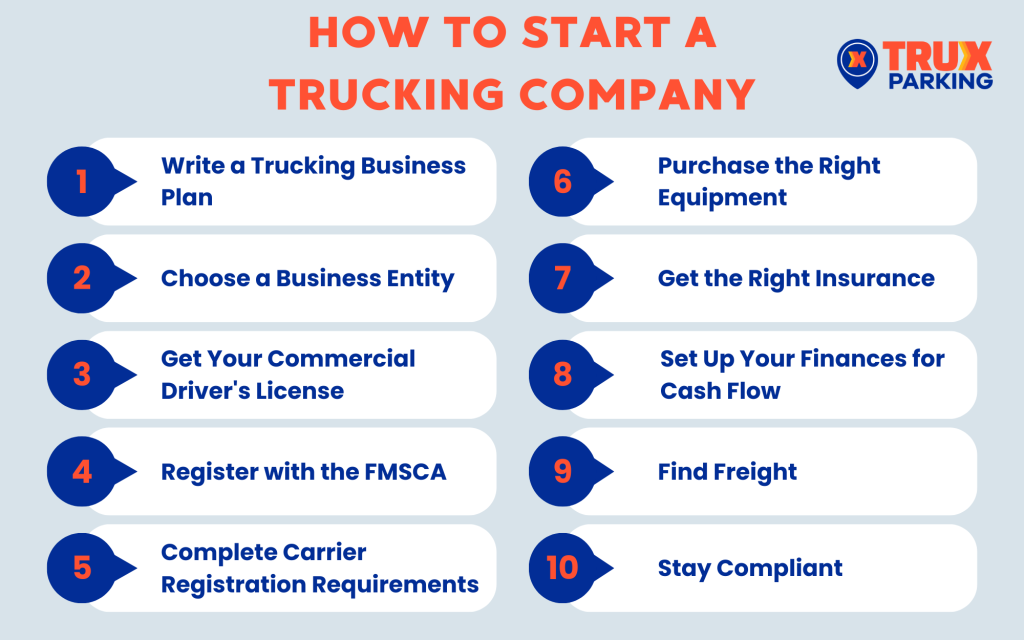
Step 1: Write a Trucking Business Plan
A solid business plan is the foundation of any successful trucking company. It does not need to be a 50-page document, but it does need to answer the key questions.
Your business plan should cover:
- What type of freight will you haul?
- Dry van, flatbed, refrigerated, hazardous materials
- Who is your target market?
- Local, regional, or long-haul
- How many trucks are you starting with?
- What are your startup costs and projected monthly expenses?
- How will you find freight?
- Load boards, freight forwarders, direct shippers
- What does your cash flow look like for the first 12 months?
A strong trucking business plan also helps if you need financing. Lenders want to see that you understand the business, not just the driving.
Step 2: Choose a Business Entity
How you structure your business affects your taxes, your personal liability, and how you handle business operations going forward.
| Business Structure | Description | Common Use Case |
| Sole Proprietorship | Simplest structure, no separation between you and the business | Single owner-operators just starting out |
| Limited Liability Company (LLC) | Separates personal assets from business debts | Most common for owner-operators and small fleets |
| Corporation (S-Corp or C-Corp) | More complex, can offer tax advantages at scale | Larger fleets with multiple employees |
Most professional drivers starting a trucking company go with a limited liability company. It protects your personal assets if something goes wrong and offers flexibility as the business grows.
Once you choose your structure, register your business name with your state, apply for an employer identification number (EIN) through the IRS, and open a dedicated business bank account.
Step 3: Get Your Commercial Driver’s License
If you are coming from outside the industry, a commercial driver’s license is required before you can legally operate a commercial vehicle. Endorsements for hauling hazardous materials or tankers require additional testing and background checks. If you plan to hire drivers rather than operate the truck yourself, your drivers will need to meet the same licensing requirements.
Step 4: Register with the Federal Motor Carrier Safety Administration
This is where the regulatory requirements start adding up. Every trucking company that operates in interstate commerce must register with the Federal Motor Carrier Safety Administration (FMCSA).
What you need from FMCSA:
- USDOT Number: Identifies your company in federal safety databases. Apply at the FMCSA website.
- Motor Carrier Authority (MC Number): Required if you are transporting goods across state lines for hire.
Registration takes time, and there is a mandatory waiting period after applying for your motor carrier authority before you can legally operate. Plan for this in your timeline.
Step 5: Complete Carrier Registration Requirements
Beyond your USDOT number and MC authority, you have additional carrier registration obligations.
Unified Carrier Registration (UCR): Required for anyone operating a commercial vehicle in interstate commerce. Fees are based on fleet size and are paid annually.
International Registration Plan (IRP): If you are registering vehicles that will travel across state lines or into Canadian provinces, you will register your trucks under the International Registration Plan. This apportioned registration system covers multiple jurisdictions under a single plate.
International Fuel Tax Agreement (IFTA): Required for trucks operating in multiple states or Canadian provinces. IFTA simplifies fuel tax reporting so you file with your base state rather than each individual jurisdiction.
Step 6: Purchase the Right Equipment
Your equipment choices affect your startup costs, your fuel costs, and what kinds of loads you can haul.
Key questions to answer:
- Buy or lease?
- Leasing reduces upfront costs but adds monthly payments.
- Buying outright builds equity but requires more capital.
- New or used?
- New trucks have lower maintenance costs early on, but higher purchase prices.
- Used trucks have lower purchase prices, but can bring surprise repair bills.
- What trailer type fits your target market?
- Dry van covers the most freight.
- Flatbed opens up construction and manufacturing loads.
- Refrigerated requires more upfront investment but can bring higher rates.
Do not over-equip at the start. One truck and one trailer running consistently beats three trucks sitting half-empty.
Step 7: Get the Right Insurance
Operating without proper insurance is not an option. The FMCSA sets minimum insurance requirements for carriers operating in interstate commerce.
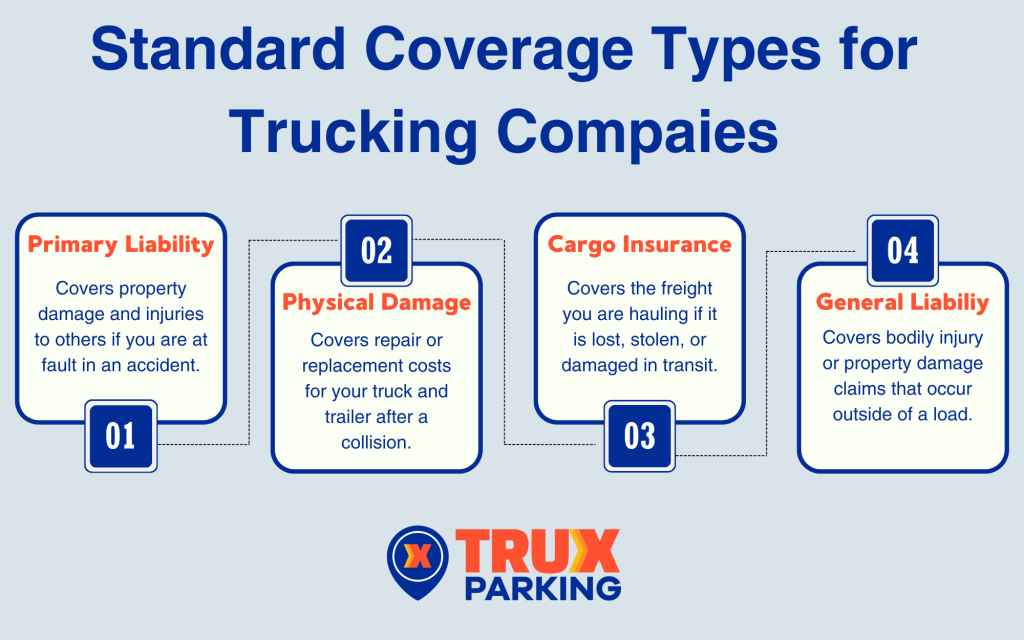
Every trucking company operating in interstate commerce needs primary liability coverage, which pays for property damage and injuries to others if you are involved in an accident. FMCSA sets minimum limits based on what you haul.
Beyond that, physical damage coverage protects your truck and trailer from collision and other damage, while cargo insurance covers the freight itself if it is lost or damaged in transit.
General liability fills in the gaps by covering incidents that happen off the road and are not tied to a specific load or accident.
Insurance is one of your biggest startup costs. Shop multiple carriers and work with an agent who specializes in commercial trucking.
Step 8: Set Up Your Finances for Cash Flow
Cash flow is one of the reasons many small trucking businesses fail. You deliver a load, invoice the broker or shipper, and then wait 30 to 60 days to get paid. Meanwhile, your fuel card, truck payment, and insurance are due now.
Ways to manage cash flow:
- Freight factoring: You sell your invoices to a factoring company at a small discount in exchange for getting paid quickly, sometimes the same day.
- Fuel cards: Many fuel cards offer discounts at truck stops across the country and help track fuel consumption.
- Reserve fund: Keep enough cash on hand to cover at least one to two months of fixed expenses.
Strategic planning around cash flow keeps your business running during slow periods.
Step 9: Find Freight
When you are just starting out, you will likely rely on load boards and freight brokers to find loads. As your business grows, the goal is to build strong relationships with direct shippers to reduce your dependence on brokers and improve your profit margin.
Common ways to find freight:
- Load boards like DAT or Truckstop.com let you search available loads by lane, equipment type, and rate.
- Freight brokers connect carriers with shippers but take a cut of the rate.
- Freight forwarders handle logistics for importers and exporters and can be a good source of consistent volume.
- Direct shipper relationships take time to build, but offer better rates and more predictable lanes.
Join the American Trucking Association and local industry groups to network and stay current on regulatory changes that affect your business.
Step 10: Stay Compliant
Regulatory compliance is not a one-time task. It is an ongoing part of running a trucking company.
Ongoing compliance obligations include:
- Driver qualification files and hours of service logs
- Annual UCR renewal
- IFTA quarterly fuel tax filings
- Drug and alcohol testing program enrollment
- Vehicle inspection and maintenance records
- FMCSA safety rating monitoring
Falling behind on compliance puts your operating authority at risk and creates serious liability exposure. Many small business owners in trucking work with a compliance consultant or use software to stay on track.

Where TRUX Parking Fits Into Your Operation
Starting a trucking company takes planning, but anyone willing to learn the business and put in the work can build something worth running. Get the legal structure right, understand your costs, stay compliant, and build the freight relationships that keep loads moving. The road ahead is open.
Once your trucking company is up and running, one of the most practical challenges is where to safely park your truck when you are not on a load. Not every yard is secure. Not every truck stop has space. And parking violations or overnight fees add up fast.
TRUX Parking provides secure truck parking across the United States. Find a TRUX location near you:
- Georgia
- Tennessee
- Alabama
- Texas
- Missouri
- Idaho
- Mississippi
- Arkansas
- Oklahoma
- Ohio
- California
- Utah
- Pennsylvania
- North Carolina
- Florida
- Oregon
- Nevada
- South Carolina
- Arizona
Every TRUX facility features electronic gated access, 24/7 surveillance cameras, industrial lighting, perimeter fencing, and wide lanes that accommodate commercial vehicles.
For owner-operators running their own trucking business, TRUX offers flexible daily and monthly parking plans with no contracts or hidden fees. Book online and get instant access instructions. Some locations also offer Wi-Fi, trash services, and on-site diesel mechanics.
When you are building a trucking company from the ground up, having a reliable, safe home base for your equipment is one less thing to worry about.
Find a TRUX Parking location near you and reserve your spot today.