



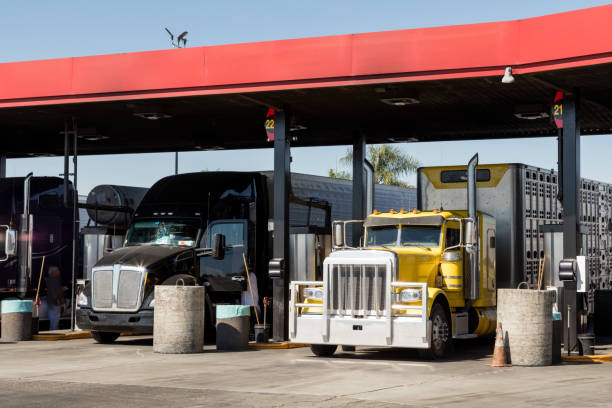
At a Glance: Most loaded Class 8 trucks average somewhere around 6 to 7 miles per gallon. Newer equipment that is run well can reach 8 or higher, and demonstration fleets have gone past 10 under favorable conditions. Your own number moves with speed, weight, terrain, idle time, tire pressure, and how the truck is spec’d. At 6 MPG, a single gallon moves you about six miles, so small habit changes show up fast over a long run.
You fill both tanks, run a week, and the number on the fuel report never quite matches what the truck is supposed to do. Two drivers can run the same truck over the same lanes and end the month with very different fuel numbers. This guide covers what a semi truck actually averages, why the figure varies so much, what each factor is worth, and how to work out your own fuel mileage instead of guessing.
The Short Answer on Semi Truck MPG
There is no single number for average miles per gallon, which is why the answers online disagree. The honest version is a range that depends on the truck and the work it does.
According to the North American Council for Freight Efficiency, the fleets in its annual Fleet Fuel Study have been running well above the national average, with the newest model-year trucks landing between 8.0 and 9.5 MPG. Those are large operations investing heavily in equipment. Most trucks on the road sit lower.
| Situation | Typical fuel mileage |
| Older commercial truck, loaded, mixed terrain | Around 5 to 6 MPG |
| Typical long-haul truck, loaded | Around 6 to 7 MPG |
| Newer truck, well spec’d, steady highway running | 7 to 8.5 MPG |
| Best-case demonstration runs under optimal conditions | 10 MPG and up |
| Empty, flat terrain, moderate speed | Higher than loaded, sometimes well into the 8s |
For the top end, NACFE’s Run on Less demonstration put seven trucks on their normal lanes with normal freight and finished at 10.1 MPG across more than 50,000 miles, at an average speed of 54 mph. A later regional haul run, on a duty cycle with far more stops, came in at 8.3 MPG.
Why Does a Semi Get So Much Less Than a Car?
Weight is the obvious answer, but it is not the only one. A loaded tractor-trailer can run around 80,000 pounds against roughly 4,000 for a car. Getting that mass moving takes fuel, and every stop throws away energy you already paid for.
The bigger factor at highway speeds is aerodynamic drag. A tractor-trailer pushes a large, boxy hole through the air, and drag climbs sharply as speed rises. That is why aerodynamic design, roof fairings, trailer skirts, and wheel covers matter so much on a truck and so little on a sedan. A modern diesel engine is genuinely efficient at converting fuel to work. The problem is how much work the truck demands.
What Actually Changes Your Fuel Mileage
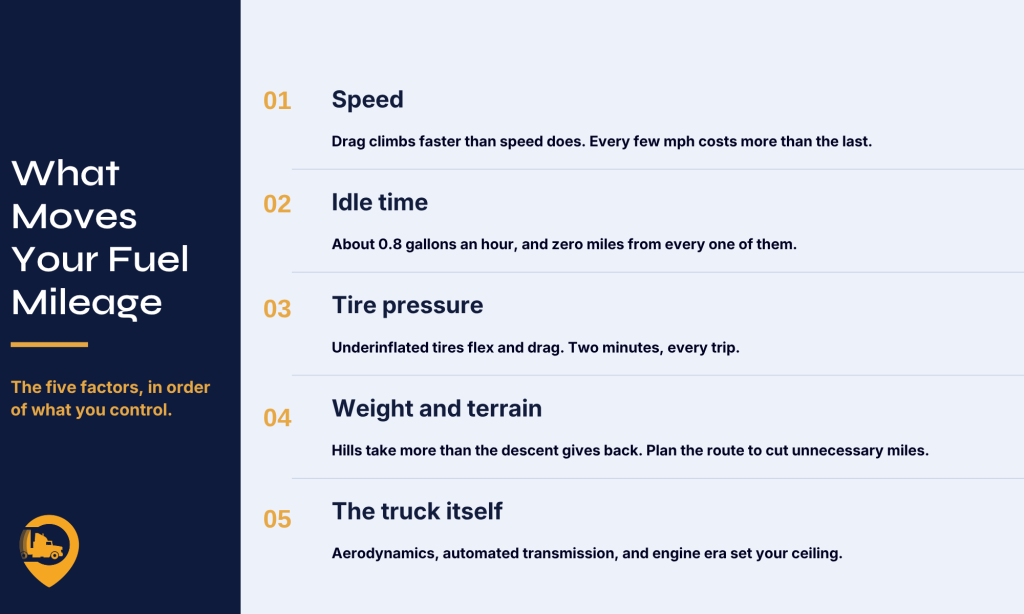
Five things move your fuel mileage, and they are listed here in order of how much control you have over each one. The first three come down to how you run the truck day to day. The last two are set by the freight, the lane, and the equipment you were handed, though even those leave room to make better choices.
Speed
Speed is the single biggest factor you control as a driver. Aerodynamic drag climbs sharply as speed rises, so each step up costs more fuel than the one before it. Higher speeds burn noticeably more fuel per mile than lower speeds over the same distance, and the time you save is usually shorter than drivers expect once you account for traffic and required breaks. Most drivers find a sweet spot in the mid 50s to low 60s, where the truck pulls comfortably in a higher gear without the engine working hard.
Idle time
Idling produces zero miles from every gallon burned, which drags your average down without appearing as a driving problem. Department of Energy analysis of idling reduction for long-haul trucks uses a working figure of 0.8 gallons per hour at idle. Run the numbers across a week of overnight stops, and excessive idling turns into real money. If your truck is equipped with an auxiliary power unit or a bunk heater, use it instead of the engine. It covers heat, air conditioning, and power for the bunk, which is most of what drivers idle for in the first place.
Tires
Underinflated tires flex more and create rolling resistance the engine has to overcome. Checking pressure is the cheapest fuel savings available to any truck driver. Under-inflated tires also wear faster and fail more often, so the walk-around pays twice. Low-rolling resistance tires cut the loss further, and many fleets pair them with a pressure monitoring system.
Weight and terrain
Weight and terrain work on each other. Extra weight costs fuel on every grade, and climbing burns more than coasting down the other side returns, so a lane through mountains will never match flat terrain. You cannot change the freight, but you can drop unnecessary miles by routing carefully and avoiding backtracking.
The truck itself
Equipment sets your ceiling. A newer truck with an aerodynamic package, an automated transmission that holds the engine in its efficient band better than most drivers manage with a manual transmission, and a current emissions-era diesel will simply do better. Every truck manufacturer now competes on freight efficiency, and models like the Freightliner Cascadia Evolution are built around it. We covered the equipment side in detail in our guide to the most fuel-efficient semi trucks.
What a Mile Per Gallon Is Worth
This is where fuel economy shows up as a real cost. The American Transportation Research Institute’s 2026 operational costs report put the industry-average cost to operate a truck at $2.336 per mile in 2025, with fuel accounting for $0.482 of it. Fuel is one of the largest line items any trucking company carries, and it moves with diesel price swings nobody controls. Across the trucking industry, that makes fuel efficiency one of the few costs a driver can influence directly from the seat.
How to Calculate Your Own MPG
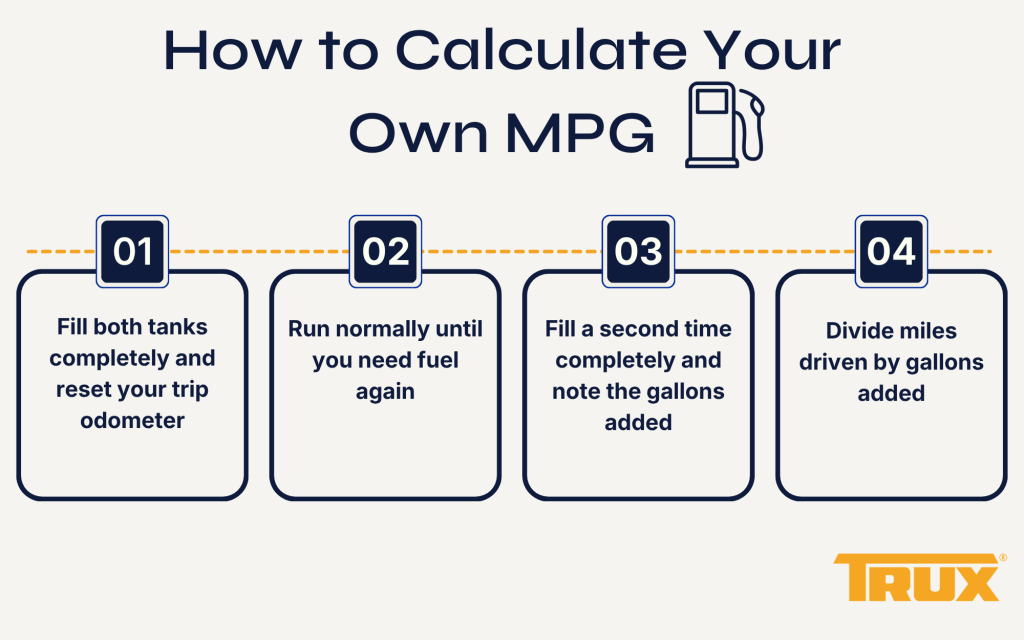
Do not rely on the dash readout alone. The reliable method takes two fill-ups:
- Fill both tanks completely and reset your trip odometer
- Run normally until you need fuel again
- Fill a second time completely and note the gallons added
- Divide miles driven by gallons added
That gives your real fuel consumption over that stretch. Repeat it across different lanes and seasons, and you will see how much your duty cycle matters. Winter blends, headwinds, and heavy traffic all pull the number down.
Habits That Add MPG
- Ease into it. Hard acceleration burns fuel you never get back. Progressive shifting into a higher gear keeps the engine in its efficient range.
- Use cruise control on flat ground. Steady speed beats constant small corrections. On rolling hills, your own throttle usually does better.
- Look far ahead. Coasting into a slowdown instead of braking late preserves momentum you already paid for.
- Cut the idle time. Use the bunk heater or APU, and plan stops where you can shut down comfortably.
- Check tire pressure cold every trip. It takes two minutes, and it works.
- Keep the truck maintained. Air filters, alignment, and dragging brakes all quietly cost fuel.
- Plan the route once. Unnecessary miles are the most expensive miles you will run.
Where Parking Fits Into Fuel Costs
Fuel and parking are connected more closely than they look. Circling a full lot at midnight burns diesel and hours. Running the engine all night for heat or air conditioning burns roughly a gallon an hour. Getting shut down early in a spot you already reserved is one of the few fuel savings available before you even start the day.
TRUX Parking gives professional drivers gated lots with electronic gate access, 24/7 security cameras, industrial lighting, perimeter fencing, and wide lanes sized for a full rig. Daily and monthly plans carry no contracts and no hidden fees, and online booking sends instant access instructions, so your spot is waiting instead of costing you laps around a crowded lot.