




At a Glance: Under federal hours-of-service (HOS) rules, a property-carrying truck driver can drive up to 11 hours after taking 10 consecutive hours off duty. All of that driving has to fit inside a 14-hour window that starts when you come on duty. After 8 hours of driving, you need a 30-minute break. Weekly, you are capped at 60 hours in 7 days or 70 hours in 8 days, with a 34-hour restart available to reset the clock. Passenger-carrying drivers run on slightly different limits.
Few rules shape a professional driver’s day more than the hours-of-service (HOS) regulations. They decide when you can roll, when you have to stop, and how long you rest before the next leg. The numbers are simple once you see them laid out, but the details around breaks, windows, and weekly limits can trip up plenty of experienced drivers. This guide walks through how many hours you can drive before needing rest, what counts against your clock, and the exceptions worth knowing.
What Are HOS Rules?
Hours-of-service regulations are federal rules that limit how long a commercial driver can work and drive before taking time off. They are set and enforced by the Federal Motor Carrier Safety Administration (FMCSA), part of the U.S. Department of Transportation. The goal is straightforward: build mandatory rest into every working day and every week to cut down on driver fatigue.
The limits apply to your duty status, which is the category your time falls into at any given moment. There are four: off duty, sleeper berth, driving, and on duty (not driving). Your electronic logging device (ELD) tracks these automatically, and it is the record an inspector checks during roadside inspections.
Who Has to Follow HOS Rules
Most professional drivers operating a commercial motor vehicle in interstate commerce fall under federal HOS rules. In general, you are required to follow the rules if you drive a vehicle that:
- Weighs 10,001 pounds or more, or has a gross vehicle or gross combination weight rating of 10,001 pounds or more
- Is built to carry 16 or more passengers, including the driver, when not operated for pay
- Is built to carry 9 to 15 passengers, including the driver, for pay
- Hauls hazardous material in a quantity that requires placards
Drivers who run only within a single state, known as intrastate commerce, follow their state’s hours-of-service rules instead. Many states mirror the federal limits closely, but intrastate drivers should always confirm the specifics where they operate.
How Many Hours Can a Truck Driver Drive Before Needing Rest?
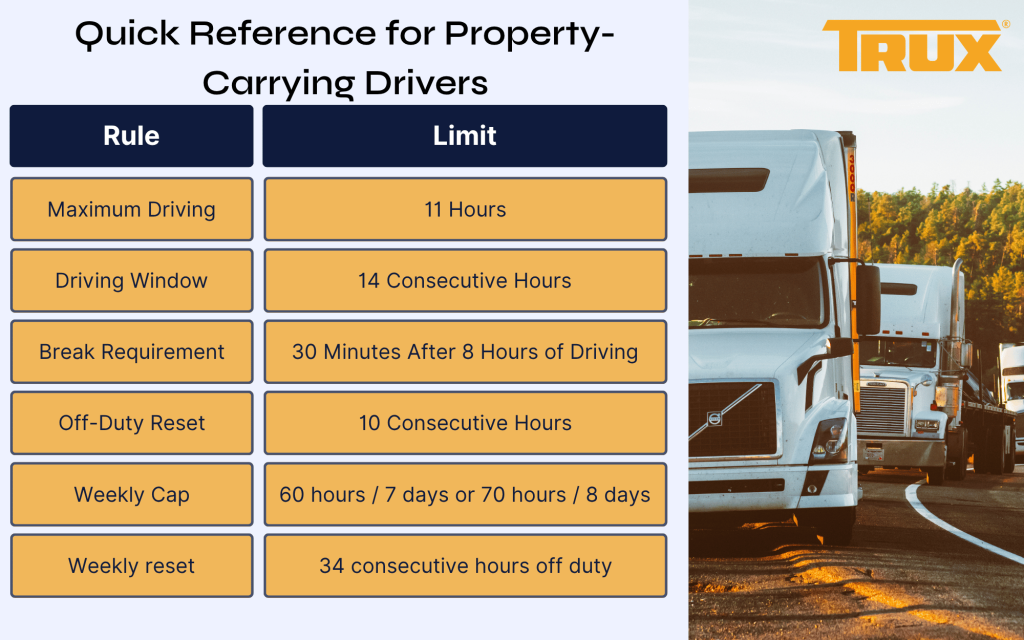
For property-carrying drivers, the short answer is 11 hours of driving. That number only makes sense alongside the window it lives inside and the break that splits it up. Here are the three daily limits that work together.
The 11-Hour Driving Limit
After 10 consecutive hours off duty, you can drive a maximum of 11 hours. Once you hit that 11th hour behind the wheel, you are done driving until you take another 10 hours off. It resets only after a full 10-hour break.
The 14-Hour Window
Here is the part that catches people. Your 11 driving hours have to fit inside a 14-hour window that starts the moment you come on duty. That clock runs straight through, and most off-duty time during the day does not pause it. Stop for a long lunch, sit at a shipper, or wait on a late load, and that time still burns against your 14-hour window. Once 14 hours pass, you cannot drive again until you take 10 consecutive hours off, even if you still have driving hours left.
The 30-Minute Break
After 8 cumulative hours of driving time, you have to take a 30-minute break before you drive again. The break can be any 30 consecutive minutes where you are not driving, so off-duty time, sleeper berth time, or on-duty time that does not involve driving all count. A meal, a fuel stop, or unloading can check the box, as long as it runs a full 30 consecutive minutes.
The 10-Hour Off-Duty Reset
When your driving day ends, the reset is 10 consecutive hours off duty. Those hours can be spent in the sleeper berth, at home, or anywhere else off the clock. Only after that full 10-hour block can you start a fresh 14-hour window with a new 11 hours of driving available. This daily off-duty time is the backbone of the system, which is why having a safe, quiet place to take it matters.
Weekly Limits: The 60/70-Hour Rule
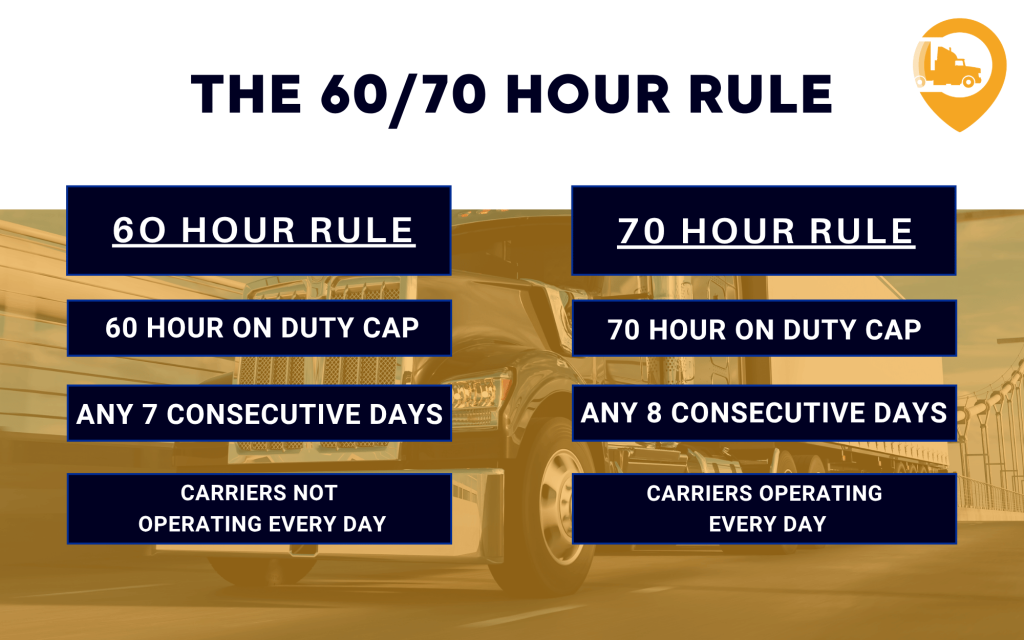
Daily limits are only half the picture. HOS rules also cap your cumulative hours over a rolling stretch of days, and which version applies depends on your carrier’s schedule.
- 60-hour / 7-day limit: You cannot drive after 60 on-duty hours in any 7 consecutive days. This applies to carriers that do not run every day of the week.
- 70-hour / 8-day limit: You cannot drive after 70 on-duty hours in any 8 consecutive days. This applies to carriers that operate every day.
You run on one or the other, not both. The clock rolls, so as each day ages out of the window, the hours you logged that day come back to you.
When your weekly hours run low, the 34-hour restart is the fastest way back. Spend at least 34 consecutive hours off duty, and your 60 or 70-hour clock resets to a full week. The restart is optional, but most drivers reach for it when the clock gets tight and a full load is waiting.
The Sleeper Berth Provision
The sleeper berth provision gives long-haul drivers greater flexibility in how they take that 10-hour break. Instead of one solid block, you can split the required off-duty time into two periods. One has to be at least 7 consecutive hours in the sleeper berth, and the other has to be at least 2 hours, either off duty or in the sleeper berth. The two periods together must add up to at least 10 hours.
When you pair a qualifying split this way, neither period counts against your 14-hour window, which can stretch how far you get on a tough schedule. The math takes getting used to, so confirm a split is legal with your ELD and carrier before relying on it.
Exceptions and Added Flexibility
Not every driver runs under the full set of limits every day. A few exceptions give certain operations more room.
The Short-Haul Exception
Short-haul drivers who stay close to home can skip some of the paperwork. If you operate within a 150 air-mile radius of your normal reporting location and finish your day within 14 hours, the short-haul exception lets you skip the ELD and the 30-minute break, using a simple time record instead. You still cannot drive beyond the daily driving limit, but the short-haul exemption cuts down on the logging.
Adverse Driving Conditions
When weather or traffic you could not have known about slows you down, the adverse driving condition rule gives you up to 2 extra hours. That means up to 13 hours of driving and a 16-hour window in those situations. It covers things like sudden snow, fog, or an unexpected road closure, not the everyday congestion you could have planned around. During declared emergency conditions, the FMCSA can also grant temporary, time-limited relief from some HOS rules, so always work from the official declaration rather than word of mouth.
Quick Reference for Property-Carrying Drivers
Passenger-carrying drivers, including many bus drivers, run on a different set of numbers: a 10-hour driving limit after 8 hours off duty, and a 15-hour on-duty limit. If you move people instead of property, confirm the passenger-carrying limits that apply to you.
Why HOS Rules Matter
Beyond the obvious goal of road safety, staying inside your hours protects your record and your wallet. Potential violations show up fast during roadside inspections, since the ELD lays out your duty status for the officer to see. Logging too many hours, missing the 30-minute break, or running past the 14-hour window can mean fines, points against the motor carrier, and being placed out of service until you have rested.
Planning around the rules also keeps a fleet running smoothly. When dispatchers build realistic schedules around HOS regulations, drivers spend less time scrambling and more time moving freight. The trucking industry runs on rested drivers, not exhausted ones.

Park Smart for Every Reset
Every one of those resets, whether a 10-hour break or a full 34-hour restart, depends on one thing: a safe place to park. Public lots fill up early, and an unsecured shoulder is the last place you want to leave your rig for an extended period of time. TRUX Parking gives professional drivers gated access, 24/7 cameras, industrial lighting, and perimeter fencing, plus wide lanes sized for full rigs and flexible daily or monthly plans with no contracts or hidden fees. Book online and get instant access instructions, so your required rest is real rest.
With secure lots across the United States, TRUX turns your off-duty hours into a stop you do not have to worry about. Select locations also offer Wi-Fi, trash service, and on-site diesel mechanics.
Find secure TRUX Parking in:
- Georgia
- Tennessee
- Alabama
- Texas
- Missouri
- Idaho
- Mississippi
- Arkansas
- Oklahoma
- Ohio
- California
- Iowa
- Pennsylvania
- North Carolina
- Florida
- Oregon
- Nevada
- South Carolina
- Arizona
- Washington
You handle the loads. Let TRUX handle the parking. Reserve your spot online today and get instant access instructions, so your next stop is one less thing to worry about. Your home away from home is ready when you are.